do flight prices go down last minute
Do Flights Get Cheaper Last Minute? The US Data Says
October 21, 2026 · 5 min read
Quick answer
Mostly no — and the reasoning matters more than the verdict. Fares move with inventory and competition, not the calendar day or your search count. The levers that work: flexible dates, the booking window, and watching for drops.
The claim: "do flight prices go down last minute." Let's test it against how airline pricing actually works in 2026.
The verdict up front
Most versions of this belief are outdated or wrong — but each myth has a grain of truth worth knowing. Here's the breakdown for the US.
What the data actually shows
- Weekday booking effects are small. Single-digit-percent averages — noise versus where on the curve you buy.
- The fare curve is what counts: 1–3 months domestic / 2–6 international, plus dodging the final-weeks premium zone.
- Competition trumps the calendar. When two airlines fight over your route, 20–40% falls off the fare. A "magic booking day" saves you ~2%.
The grain of truth
- Early-week sale filings are real — so deal emails and fare drops show up statistically more on Mondays and Tuesdays. Tuesday booking isn't the magic; being watching when sales land is.
- Prices vary by point of sale — the country and currency of purchase. Niche, but genuine.
What actually saves money instead
- Flexible dates — the single biggest lever: 15–40% on any route
- Book when the window is open — sidestep last-minute premiums
- A target price on automated watch — drops land at random hours and disappear quickly
That last one is exactly what AirAlarms does for travelers in the US: set your number once, get pinged the moment your route crosses it. Myths don't save money — watching does.
The fare curve, week by week
Do fares fall closer to departure? The honest answer is a curve, not a yes/no:
| Weeks before departure | Fare trend |
|---|---|
| 20+ | High — sale fares not yet loaded |
| 8–16 | Lowest — cheap buckets open, competition active |
| 4–8 | Flat, with sale dips |
| 2–4 | Climbing |
| 1–2 | Steep climb — premium zone |
| Final days | Highest, except rare fire sales |
The "prices drop at 6 weeks" belief is a distorted memory of the old 21-day advance-purchase rule — a real fare-structure break that used to sit at exactly 3 weeks (and still does on some fares). Today the breaks are softer and route-dependent, but the shape holds: the window is where the deals live, and the final fortnight is where they go to die. Waiting for a late drop on a seat you need is how people pay the top of the band.
Local rules and quirks that move prices
- The 24-hour DOT rule obliges carriers to offer free cancellation for a day after booking (on departures 7+ days out) — consumer protection that legitimizes book-first, watch-second
- Southwest still includes two checked bags and prices as a bundle, which makes its "expensive" sticker fares cheaper than they look next to LCC totals
- Spirit, Frontier, JetBlue, Southwest — the LCC segment — move the floor; when an ULCC arrives, the Big 3 respond within days
The New York wrinkle
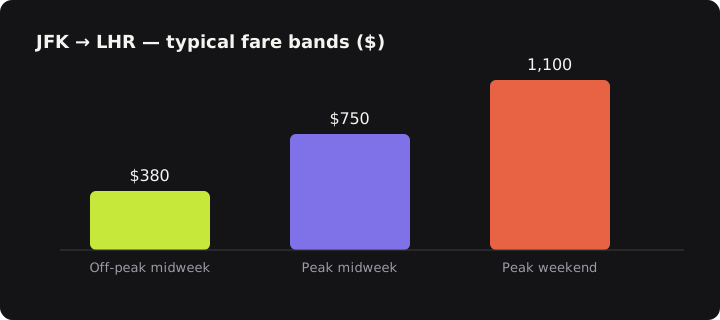
three airports (JFK, LGA, EWR) price independently — EWR often wins on transatlantic, LGA on domestic, and the spread between them can exceed $100 on the same day. A city like New York bends the whole country's average — one more reason a specific route beats generic advice.
How to test pricing folklore yourself
Trust nothing on faith — ours or any blog. Each claim here is testable in a single evening:
- Pick one route you know well — say New York to London on Delta
- Monitor the same flight number at matching times over several days — the same flight, always
- Repeat the check in a private window, on your phone, and through a VPN exit abroad — log every result
- Then slide the date three days either way and track the price reaction
Anyone who tests this properly lands on the same finding: shifting dates moves prices more than cookies, browsers or weekdays ever will. The ±3-day test alone regularly shows 15–30% swings — that's the real lever, and it's why [flexible-date watching](fare alerts) tops every tactic ranking we've run.
What the myth gets right
Folklore usually starts from something real. It is true that sale fares get filed more often early week — hence deal emails bunching on Mondays and Tuesdays. Point-of-sale pricing genuinely differs by country. But filing day describes airline systems, not your screen — a sale already published prices the same whichever day you click. What matters is being [watching when it lands](incognito mode tested).
Where travelers get it wrong
- Testing myths across different flights. Only the same flight number across times and browsers is a fair test — different flights prove nothing.
- Mistaking depletion for spying. "The fare rose when I checked!" usually means the cheapest bucket sold — a process indifferent to observers.
- Dismissing all timing. The myths collapse, yet the real lever — where on the curve you book — stands.
Worth knowing
Airline pricing and refund rules shift constantly — we keep an eye on the official sources (the U.S. DOT publishes the rules here) so the advice above stays current.
Common questions, straight answers
Tuesday booking myth — does it hold up?
No reliable effect. Filings skew early in the week and emails follow — but the checkout price depends on that moment's inventory, not the day of the week. Watch one flight for seven days and the differences run a few percent.
Does clearing cookies make flights cheaper?
No. Routes carry dynamic inventory pricing; browsers carry none. Between checks, what moves is fare-bucket availability — cheapest tiers truly do sell out between searches, cookies or not.
Why do prices seem different on my phone?
Usually a different point-of-sale (app vs web can use different markets/currencies) or simply time passed between checks. Test the same flight, same market, minutes apart before concluding device-based pricing.