do flight prices change based on location
Do Flight Prices Change Based on Where You Search From?
October 7, 2026 · 5 min read
Quick answer
Mostly no — and the reasoning matters more than the verdict. Fares move with inventory and competition, not the calendar day or your search count. The levers that work: flexible dates, the booking window, and watching for drops.
The claim: "do flight prices change based on location." Let's test it against how airline pricing actually works in 2026.
The verdict up front
Most versions of this belief are outdated or wrong — but each myth has a grain of truth worth knowing. Here's the breakdown for the US.
Where the myth came from
Airline revenue management changed. Back then — twenty years ago — fares sat in rigid published tiers, weekly-updated; real patterns emerged (Saturday-night stays, Tuesday filings). Today:
- Dynamic fares: recomputed live by demand algorithms
- Hundreds of price points per flight, run by pricing teams
- Hours, not weeks, are the competitive clock
Tricks built on a weekly filing cadence are probing a defunct system.
What the data actually shows
- Weekday effects barely register. A few percent across days — noise next to how far from departure you book.
- Position on the fare curve decides: 1–3 month domestic and 2–6 month international windows, steering clear of the last-weeks premium.
- Calendar tricks lose to competition. Two airlines contesting your route routinely save you 20–40%. A "magic booking day" saves you ~2%.
What actually saves money instead
- Date flexibility — worth 15–40% anywhere; no other lever comes close
- Booking inside the window — and skipping last-minute premiums entirely
- A target price on automated watch — drops land at random hours and disappear quickly
That last one is exactly what AirAlarms does for travelers in the US: set your number once, get pinged the moment your route crosses it. Myths don't save money — watching does.
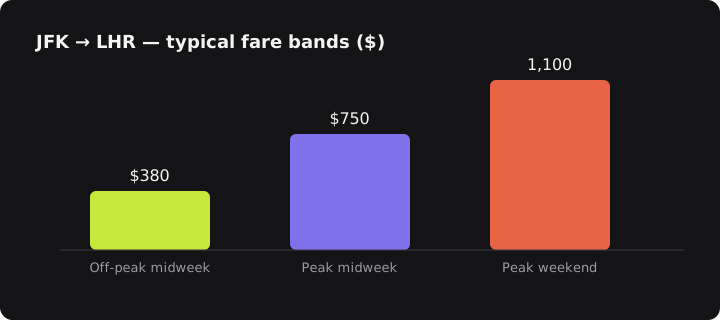
Point-of-sale pricing: the real geography effect
Unlike cookies and Tuesdays, geographic pricing is real — just narrower than the legends claim:
- Airlines price by point of sale: the same LHR–JFK seat can price differently when bought in the UK (in GBP) vs the US (in USD), reflecting local competition, taxes, and purchasing power
- The differences are usually 5–15%, occasionally more on competitive routes — not the 10× legends
- Payment friction is the catch: many airlines decline foreign cards without a local billing address, and currency conversion fees eat thin margins
- It works best on regional carriers in Asia and the Middle East; it barely exists within domestic US markets
Trying it legitimately: compare prices with your VPN off, check the airline's country-specific site, and factor card fees before celebrating. The savings are real but modest — and dwarfed by date flexibility on the same route.
Local rules and quirks that move prices
- Under the DOT's 24-hour rule, airlines must let you cancel free within a day of booking (departures a week or more out) — a right that turns book-then-watch into a legitimate play
- Big 3 basic economy (American, Delta, United) strips seat selection and changes — that, against a standard economy fare, is the comparison worth making
- Spirit, Frontier, JetBlue, Southwest — the LCC segment — move the floor; when an ULCC arrives, the Big 3 respond within days
The Chicago wrinkle
Midway (MDW) and O'Hare split the market — MDW's LCC-heavy schedule means sale fares appear there first, and ORD matches within days. Chicago is one city reshaping the national average — exactly why your route, not a guide, should set your target.
How to test pricing folklore yourself
No need to trust this site — or any article. You can verify every claim on this page in one evening:
- Pick one route you know well — say New York to London on Delta
- Monitor the same flight number at matching times over several days — the same flight, always
- Repeat the check in a private window, on your phone, and through a VPN exit abroad — log every result
- Then slide the date three days either way and track the price reaction
Run the test honestly and you get one answer: date shifts beat cookies, browsers and booking days combined. The ±3-day test alone regularly shows 15–30% swings — that's the real lever, and it's why [flexible-date watching](fare alerts) tops every tactic ranking we've run.
The part of the myth that survives testing
Folklore usually starts from something real. Sale emails do bunch early week — filings genuinely skew toward the start of the week. Point-of-sale pricing genuinely differs by country. Yet "filed Tuesday" describes inventory systems, not checkout pages — once a sale is live on a consumer site, your click-day changes nothing. What matters is being [watching when it lands](booking windows).
The mistakes that quietly cost money
- Using different flights to test folklore. The only fair test holds the same flight number constant across times and browsers.
- Confusing sell-outs with being watched. "Price rose after my search!" typically means the cheapest tier emptied — no observer required.
- Throwing out timing altogether. Myths fail, but the lever underneath (booking where on the fare curve) is genuinely real.
Worth knowing
Airline pricing and refund rules shift constantly — we keep an eye on the official sources (the U.S. DOT publishes the rules here) so the advice above stays current.
Frequently asked questions
Are Tuesday bookings actually cheaper?
No reliable effect. Deal emails cluster early week because filings do — yet your price is set by inventory when you book, not by the calendar day. Seven days of tracking one flight yields differences in the low single digits.
Does clearing cookies make flights cheaper?
No. Pricing is per-route and inventory-driven, not per-browsing-session. Between checks, what moves is fare-bucket availability — cheapest tiers truly do sell out between searches, cookies or not.
Why do prices seem different on my phone?
Usually a different point-of-sale (app vs web can use different markets/currencies) or simply time passed between checks. Test the same flight, same market, minutes apart before concluding device-based pricing.