ways to find cheap flights from us
9 Ways to Find Cheap Flights from the US
October 15, 2026 · 5 min read
Quick answer
The floor sits at late January–March, May, and September–October — the structural cheap stretches; June–August and mid-December carry the premiums. Combine a cheap month with a watched window and bottom-decile fares follow.
Most lists copy each other. This one ranks by measured savings on the US routes — including the tactics that sound good and deliver nothing.
The rankings (by realistic savings)
1. Nearby airports — worth 5–20%
Cross-town rivals and second cities — New York (JFK) has them — often price the same trip very differently.
2. Deal communities and newsletters — worth 0–25% (high variance)
The wins are real but random-routed and short-lived. Flexibility converts them; fixed plans do not.
3. Incognito mode / cookie myths — worth ~0%
The test results are in: fares track route inventory, not cookies. A price that "moved on refresh" was a bucket selling, not spying.
4. One-way + one-way on separate carriers — worth 0–15%
Splitting the trip across two carriers still occasionally undercuts the round trip — a legacy-pricing relic worth five minutes of checking.
5. Flexible dates — worth 15–40%
Nothing else comes close. A 2–3 day date shift regularly outperforms all other tactics combined, and any month-view price tool exposes the spread instantly.
6. Booking inside the window — worth 10–25%
1–3 months out for domestic, 2–6 for international (from our booking-window guide). Book earlier and you often overpay; later and the premium zone starts.
7. Automated target-price watching — worth 10–30% + drops you would never see
Invert the work: prices come to you. AirAlarms monitors your route around the clock and pings the moment your number is crossed — overnight sales and hour-long flash drops included. Consistent savers operate exactly this way.
8. Route competition — worth 20–40% where it exists
Competition is the mechanism: two airlines on one route drag each other down. A nearby alternate airport occasionally adds the second.
The honest combo that works
- Choose a cheap-month travel window (see the cheapest months guide)
- Search with flexible dates once, to learn your route's real band
- Set a target price 10–15% below the current fare
- Let AirAlarms watch — book the moment your number hits
That's the whole system. Everything else on this page is either a subset of it or folklore.
The US playbook: where the deals actually hide
The US market has specific hiding spots most lists miss:
- Secondary airports on transcontinental routes: EWR vs JFK, MDW vs ORD, OAK/SJC vs SFO — the same trip prices differently by airport, and the LCC-heavy secondaries (Southwest, Spirit, Frontier bases) set the floor
- Fortress-hub workarounds: out of Atlanta, Charlotte, or Salt Lake City, driving 2–3 hours to a competitor hub can cut fares 20–40% — the hub premium is real and quantifiable
- The Big 3 sale calendar: American, Delta and United file system-wide sales in January and early September; matching happens within ~72 hours, so the sale window is a week, not a day
- Basic economy arbitrage: with no bags and no seat preference, basic economy on the Big 3 is the cheapest legitimate cross-country product — but price the bag before committing
- Positioning for international: US domestic sales sometimes make a positioning flight + separate long-haul cheaper than the through-fare — price the segments separately before booking
The meta-tactic that beats all of these: set target prices on the 2–3 routes you actually fly. US fare wars are frequent enough that a watched route gets hit several times a year.
Local rules and quirks that move prices
- DOT regulation gives you free cancellation for 24 hours post-booking (when departure is a week+ away) — the consumer right that makes booking-then-watching real
- Big 3 basic economy (American, Delta, United) strips seat selection and changes — that, against a standard economy fare, is the comparison worth making
- Spirit, Frontier, JetBlue, Southwest — the LCC segment — move the floor; when an ULCC arrives, the Big 3 respond within days
The New York wrinkle
three airports (JFK, LGA, EWR) price independently — EWR often wins on transatlantic, LGA on domestic, and the spread between them can exceed $100 on the same day. A city like New York bends the whole country's average — one more reason a specific route beats generic advice.
How we ranked these
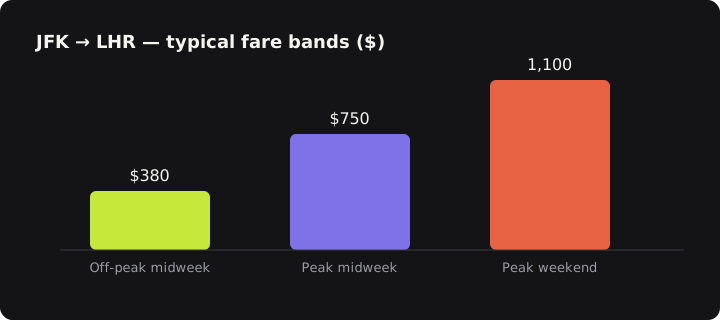
The savings percentages above aren't pulled from the air — each comes from the same method: take a route's normal fare band (like New York→London at $380–550–$750–1,100), apply the tactic, and measure against the band midpoint. That method has quirks:
- Percentages are ranges, not promises. A tactic worth "15–40%" delivers 40% when a fare war is on and 15% on a quiet route.
- Tactics don't stack linearly. Flexible dates and a nearby airport usually beat the sum of their individual savings — they compound.
- Variance matters as much as average. Deal communities average lower than automation but with huge variance: brilliant fares that die in hours, and weeks of nothing. A [target-price alert](booking window guide) is the same discovery engine with the noise removed.
The 15-minute setup that captures most of this list
If you do only one thing from this page: pick your most likely trip this year, search it once with flexible dates to learn the real band, then set a target 10–15% below the current fare. That's tactics #1, #2 and #3 in a single move — and it's 15 minutes, once, not a daily habit.
Where travelers get it wrong
- Stacking tactics that don't stack. Flexible dates and nearby airports compound; booking-day folklore and incognito mode add nothing to either.
- Optimizing for the average, not your trip. A tactic worth "20% on average" may be worth 0% on your specific route — test the band, then decide.
- Spending hours to save single digits. Your checking time has value. Automate the watching and spend the hours on the trip itself.
Worth knowing
Airline pricing and refund rules shift constantly — we keep an eye on the official sources (the U.S. DOT publishes the rules here) so the advice above stays current.
Frequently asked questions
What is the #1 way to find cheap flights?
Flexible dates, by a wide margin — worth 15–40% on typical routes. Shifting a departure two or three days routinely beats every other tactic, and it's why flexible watching is the core of [target-price alerts](mistake fares).
Do flight deal newsletters actually save money?
For flexible travelers, genuinely yes — great fares surface there first. But they're random routes and die within hours, and the noise-to-signal ratio is brutal. Watching your routes with a target captures the same drops without the inbox flood.
How far in advance should I book to get the cheapest flight?
1–3 months for domestic, 2–6 for international, per our full [booking window guide](booking window guide). A watched drop inside those windows beats every calendar maneuver.