flight deal websites compared
Every Flight Deal Website Compared
October 19, 2026 · 5 min read
Quick answer
Structurally cheap: late January through March, May, September–October. Structurally dear: June–August and mid-December. A cheap month plus a watched booking window equals bottom-decile pricing.
A ranked list with a difference: each tactic carries its realistic savings range for the US routes, and the folklore is called out as folklore.
The rankings (by realistic savings)
1. Nearby airports — worth 5–20%
Cross-town rivals and second cities — New York (JFK) has them — often price the same trip very differently.
2. Deal communities and newsletters — worth 0–25% (high variance)
Real deals appear — random routes, gone within hours. Gold for the flexible; static for everyone else.
3. One-way + one-way on separate carriers — worth 0–15%
Two one-ways on different airlines sometimes beat the cheapest round trip — legacy pricing quirks keep this alive. Price both structures before committing.
4. Point-of-sale arbitrage — worth 0–12% (niche)
Point-of-sale differences exist: the identical fare, bought in another currency, sometimes costs less. Timebox the experiment.
5. Flexible dates — worth 15–40%
The undisputed champion. Shifting departure by 2–3 days routinely beats every other tactic combined. Any tool that shows a month view of prices lets you exploit this in seconds.
6. Booking inside the window — worth 10–25%
1–3 months out for domestic, 2–6 for international (from our booking-window guide). Book earlier and you often overpay; later and the premium zone starts.
7. Automated target-price watching — worth 10–30% + drops you would never see
Stop visiting fares; let fares find you. AirAlarms keeps a 24/7 watch on your route and pings only at your target — catching the midnight sales and short-lived drops manual checking never sees.
8. Route competition — worth 20–40% where it exists
Competition is the mechanism: two airlines on one route drag each other down. A nearby alternate airport occasionally adds the second.
The honest combo that works
The stack, in order:
- Pick a cheap month (calendar here)
- Learn the band — one flexible-dates search
- Target 10–15% under the fare you found
- AirAlarms holds the watch; you book when the ping lands
Everything else above is a subset of this loop — or folklore.
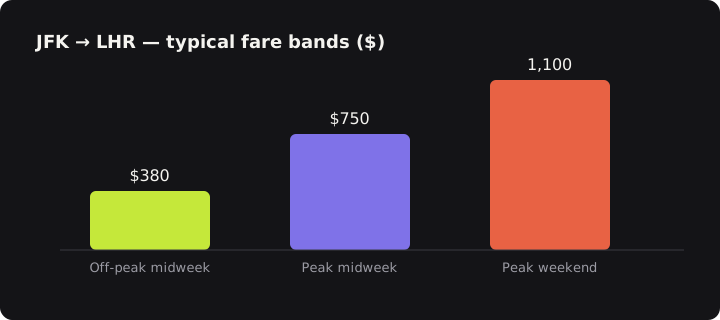
Practice route: JFK–LHR
If you want one route to practice on: JFK–LHR. Honest bands are roughly $380–550–$750–1,100 return. Every tactic on this page — windows, flexibility, targets — is testable on it within a couple of months of watching.
The market-specific stuff most guides skip
- Under the DOT's 24-hour rule, airlines must let you cancel free within a day of booking (departures a week or more out) — a right that turns book-then-watch into a legitimate play
- Hub dominance is the hidden variable: out of fortress hubs like Atlanta, Charlotte, Dallas and Salt Lake City, competition is thinner and fares structurally higher than the national average
- Sales cluster around January (post-holiday) and early September, but flash sales fire year-round — the schedule is a tendency, not a rule
The New York wrinkle
three airports (JFK, LGA, EWR) price independently — EWR often wins on transatlantic, LGA on domestic, and the spread between them can exceed $100 on the same day. New York is one city reshaping the national average — exactly why your route, not a guide, should set your target.
How we ranked these
The savings percentages above aren't pulled from the air — each comes from the same method: take a route's normal fare band (like New York→London at $380–550–$750–1,100), apply the tactic, and measure against the band midpoint. That method has quirks:
- Percentages are ranges, not promises. A tactic worth "15–40%" delivers 40% when a fare war is on and 15% on a quiet route.
- Tactics don't stack linearly. Flexible dates and a nearby airport usually beat the sum of their individual savings — they compound.
- Variance matters as much as average. Deal communities average lower than automation but with huge variance: brilliant fares that die in hours, and weeks of nothing. A [target-price alert](booking window guide) is the same discovery engine with the noise removed.
The 15-minute setup that captures most of this list
If you do only one thing from this page: pick your most likely trip this year, search it once with flexible dates to learn the real band, then set a target 10–15% below the current fare. That's tactics #1, #2 and #3 in a single move — and it's 15 minutes, once, not a daily habit.
The official line
Booking rules (cancellation windows, fare-display requirements) are set by regulators; the U.S. DOT's current guidance is worth a skim before any big purchase.
Frequently asked questions
What is the #1 way to find cheap flights?
Flexible dates, by a wide margin — worth 15–40% on typical routes. Shifting a departure two or three days routinely beats every other tactic, and it's why flexible watching is the core of [target-price alerts](fare alerts).
Do flight deal newsletters actually save money?
For flexible travelers, genuinely yes — great fares surface there first. But they're random routes and die within hours, and the noise-to-signal ratio is brutal. Watching your routes with a target captures the same drops without the inbox flood.
How far in advance should I book to get the cheapest flight?
1–3 months for domestic, 2–6 for international, per our full [booking window guide](booking window guide). Within those windows, watching for the drop outperforms any calendar trick.
Where travelers get it wrong
- Stacking tactics that don't stack. Flexible dates and nearby airports compound; booking-day folklore and incognito mode add nothing to either.
- Optimizing for the average, not your trip. A tactic worth "20% on average" may be worth 0% on your specific route — test the band, then decide.
- Ignoring total trip cost. The cheapest seat with paid bags, seats, and transfers can lose to a fairer fare with everything included.