cheap business class to europe from us
Cheap Business Class to Europe from the US
October 1, 2026 · 5 min read
Quick answer
The reliable path: book the January–February or September–October sale windows, where premium cabins drop 30–40%, and watch your specific route with a target alert. Upgrades-at-check-in and bids fill the gaps.
Riding up front is not about points games or luck. Know where premium fares fall on structure — then be watching when they land there. A realistic guide for the US.
The five strategies that actually work
1. Book the sale windows
Two sale seasons matter for premium: the January–February demand trough and the September–October shoulder. On transatlantic TATL routes and Pacific routes, business fares in those windows routinely sit 30–40% under the summer norm.
2. Fly the competition routes
Airlines with new premium products price aggressively to fill them. When a new carrier enters a route, business fares fall across the board for months.
3. Bid upgrades and spot-check-in offers
Many carriers (and most Gulf/Asian airlines) run pre-departure upgrade auctions. Check in early and ask — upgrade offers at check-in are sometimes 20–30% of the business fare.
4. Premium economy as the sweet spot
Premium economy is the best value-per-money in the cabin hierarchy — typically 60–80% more than economy, a fraction of business. On long-haul from the US, it's the rational upgrade for most travelers.
5. Watch fares like a pro
Premium fares don't drift down — they drop in steps during sales and sit high otherwise. That means the winning move is identical to economy: set an ambitious target and let automation watch.
The math that changes everything
A business class return that's normally $4,000–6,000 appearing at $1,800 in a sale isn't a discount — it's a different purchase. The regulars up front aren't wealthier — they're watching when buckets open.
Set your premium target on AirAlarms once. A business fare crossing your line — scheduled or random Tuesday — triggers the ping, and you book within minutes.
What doesn't work
- "Student/consolidator" sites touting 90% off — largely bait
- Waiting on check-in upgrades for 11-hour sectors — economy is the destination
- Points strategies minus the points — for most people the cash-sale path wins on speed
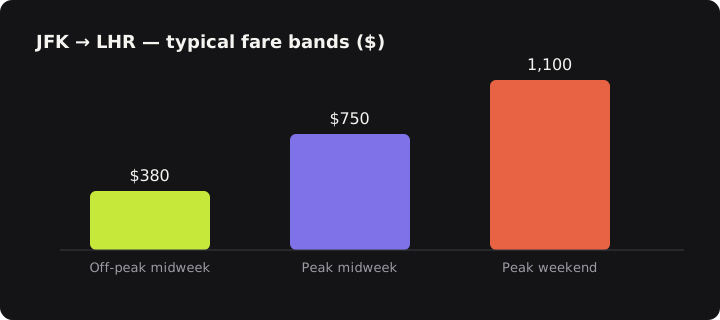
Transatlantic premium: the competition map
The transatlantic premium market is unusually competitive, which is your leverage:
- Norse Atlantic, French Bee, PLAY — low-cost long-haul with genuinely cheap premium cabins ( recliner-style seats at 40–60% off legacy pricing)
- Legacy sales (BA, Virgin, Delta, United) fire in January and September — business class routinely drops 30–40%
- Positioning via Dublin or Shannon — Ireland's US preclearance plus Aer Lingus pricing makes westbound departures structurally cheaper
- Shoulder seasons — April–May and September–October premium fares run 20–30% under July
The structural story: low-cost long-haul entrants permanently lowered the floor on routes they fly, and legacies match on price rather than concede. If your route has a low-cost premium option, the legacy fare above it is a ceiling, not a fact.
The market-specific stuff most guides skip
- The 24-hour DOT rule obliges carriers to offer free cancellation for a day after booking (on departures 7+ days out) — consumer protection that legitimizes book-first, watch-second
- American, Delta and United sell basic economy without seat selection or changes — the honest comparison is that fare versus standard economy
- Refund rights: if an airline cancels or significantly delays a flight and you decline rebooking, you're entitled to a cash refund — not just a credit
The New York wrinkle
three airports (JFK, LGA, EWR) price independently — EWR often wins on transatlantic, LGA on domestic, and the spread between them can exceed $100 on the same day. A city like New York bends the whole country's average — one more reason a specific route beats generic advice.
What premium comfort actually costs per hour
Judge premium fares by the flight-hour, not the ticket. On a 10-hour long-haul from the US:
| Cabin | Typical fare band | Cost per hour | What you get |
|---|---|---|---|
| Economy | $385–550 | ~$35–45 | A seat |
| Premium economy | ~60–80% above economy | ~$60–75 | Real width, better meal, priority |
| Business (sale) | $1650–2750 | ~$200–350 | Lie-flat, lounge, arrival functional |
That premium economy row is the sweet spot for a reason: per flight-hour, it is aviation's cheapest comfort upgrade. Walk-up business roughly doubles per-hour cost for the same seat — which is the whole case for sale windows.
The upgrade-offer playbook
Can't stretch to a full premium fare? The secondary upgrade market can:
- Flexible economy, then bids — the airline's own bid/offer system typically opens 2–5 days before departure
- Early check-in plus a polite ask — gate and desk agents control upgrade stock the airline is motivated to fill
- Watch for fare-class drops — when a sale empties business buckets, upgrade offers get cheaper too; another thing [alerts](business class sale windows) catch for you
FAQs
Cheapest route into a business-class seat?
The January–February and September–October windows cut long-haul business 30–40% — book inside them, and run a target alert on your own route for fare drops. Upgrades-at-check-in and bid systems fill the gaps.
Is premium economy worth the money?
Past 8 hours, usually yes: real width, better meal, priority — 60–80% above economy, a fraction of business. On short-haul it's rarely worth the premium.
Has business class ever sold at economy prices?
Yes: sale windows, new-route promotions, occasional pricing errors. They're rare and die fast, which is exactly why [target watching](business class sale windows) is the reliable way to be there when it happens.
Where travelers get it wrong
- Walk-up business fares. Same seat, but 2–3× the sale-fare price. Never buy premium at the last minute.
- Writing off premium economy. Value-per-hour champion of the cabin hierarchy — often more rational than either economy or business.
- Churning cards outside your control. When fees and spend rules outrun award value, points strategies leak money.
The official line
Booking rules (cancellation windows, fare-display requirements) are set by regulators; IATA's current guidance is worth a skim before any big purchase.