flight alerts that work
Flight Price Alerts That Actually Work (Not Just Spam)
October 20, 2026 · 5 min read
Quick answer
Cheapest months to fly: January–March, May, and September–October. Most expensive: July–August and the Christmas stretch. Below sits the full calendar — and the strategy that layers on top of it.
Alerts are fare hunting's highest-leverage tool; most people configure them into silence or spam. Here's the version that works for the US.
The setup that works (any tool)
- Pin the exact route and dates — or a flexible month, if dates are movable; flexible watching finds the biggest drops.
- Target price over "notify me." The skipped step, every time. No target means every ±$15 wobble becomes an email — and trains you to ignore emails. With a target ("ping me under $450"), silence means nothing's worth your attention.
- Match target to reality. Far below any fare ever sold is not discipline — it is silence on subscription. Study the route's real prices and pin the target to the bottom of the band.
- One alert per trip that genuinely matters. Quality over quantity.
Why target-based alerts win
| Approach | What you get |
|---|---|
| "Tell me about changes" | 6 emails a week of ±20 noise — trained to ignore |
| "Tell me when it drops 10%" | Better, but a 10% drop on an overpriced fare is still overpriced |
| "Ping me under my number" | Near-zero noise; every email is bookable |
Deal professionals run on the third approach — which is exactly the AirAlarms model. We watch your route's fare changes around the clock; the ping fires only when your actual number is met. No daily digest of noise.
Two alert mistakes that waste months
- Setting alerts 9 months out and hoping. Airlines haven't loaded sale fares that far ahead. Set the alert, but expect the real drops in the 1–5 month window.
- Forgetting to set return legs separately. If your tool only tracks one-way fares, your "return" alert is fictional. AirAlarms prices the actual round trip — the number you see is the number you book.
The honest limits
No alert tool can see every airline's internal sales instantly, and ultra-cheap fares die fast. When a ping lands, book within the hour — not the weekend.
The alert lifecycle — setup through booking
The full arc in view is what makes watching work. Here's how a well-set alert actually plays out on a typical the US route:
- Day 0 — setup. The route currently sells for $532 return. You set a target of $380 — at the bottom of the normal band, not a fantasy number.
- The first nine days: silence. That is the system functioning, not failing. Every small wobble stays below your noise floor.
- Day 10, the drop. Sale-matching by a rival; your line crossed at 06:40. The ping lands before you're awake.
- Day 10, 08:15: you buy. Noon finds the fare snapped back to its old level. Total checking effort on your part: one email.
Manual checkers lose exactly that third step. Sale fares on the US routes routinely last hours — the average big drop is gone within a day.
The moment a ping lands: what to do
- Check the fare rules first — baggage, changes, refundability — before paying, never after
- One reservation for outbound and return where the tool allows — protection if a leg is reshuffled
- Book inside the hour. Deal velocity is real — the fare in front of you is being sold to everyone who set the same target
- Photograph the fare before paying — evidence if the seller's checkout glitches
The setup difference between alert systems matters more than most people realize — our [booking-window guide](best time to book flights) explains why targets beat "notify me of changes," and [mistake fares](cheapest months) show what happens when you're watching when an error fare lands.
Practice route: JFK–LHR
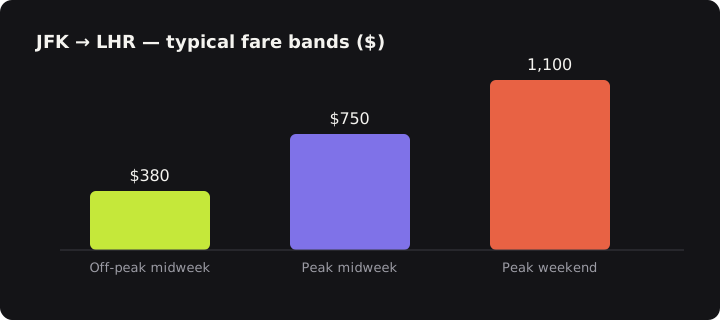
If you want one route to practice on: JFK–LHR. Honest bands are roughly $380–550–$750–1,100 return. Every tactic on this page — windows, flexibility, targets — is testable on it within a couple of months of watching.
The market-specific stuff most guides skip
- DOT regulation gives you free cancellation for 24 hours post-booking (when departure is a week+ away) — the consumer right that makes booking-then-watching real
- Hub dominance is the hidden variable: out of fortress hubs like Atlanta, Charlotte, Dallas and Salt Lake City, competition is thinner and fares structurally higher than the national average
- Sales cluster around January (post-holiday) and early September, but flash sales fire year-round — the schedule is a tendency, not a rule
The Los Angeles wrinkle
Burbank and Long Beach undercut LAX regularly on domestic routes; the time saved clearing a smaller airport is real. Los Angeles is one city reshaping the national average — exactly why your route, not a guide, should set your target.
The official line
Booking rules (cancellation windows, fare-display requirements) are set by regulators; the U.S. DOT's current guidance is worth a skim before any big purchase.
Frequently asked questions
Are flight price alerts free?
Yes on AirAlarms — your first alert is free, set a target, get emailed when it hits. Competitor tools split into free-with-limits and paid; the real differentiator is not price but whether alerts are target-based — a ping only when bookable at your number — versus noisy change notifications.
How far ahead does a fare alert need setting?
As soon as you know the trip. Carriers load sale fares 6–11 months ahead; an early alert sometimes catches the filing, though dependable drops arrive inside 1–5 months. Set it early; act when it fires.
Do price alerts work for the US routes?
Yes — alerts watch the same public fares you'd see searching manually, on Delta, United, American, Southwest, Alaska, JetBlue and Southwest, Spirit, Frontier, Breeze alike. Coverage is the advantage: a 06:00 or mid-commute drop is caught the minute it lands, not the evening you happen to look.
Mistakes that cost readers the most
- Setting unreachable targets. 50% below anything ever sold doesn't read as discipline; it reads as never being pinged.
- Per-date alerts instead of per-trip. The flexible-date drops — routinely 15–40% cheaper — are invisible to rigid dates.
- Leaving the email a day. Good fares don't wait. The ping acted on hourly books; the one left weekly often doesn't.