last minute flight deals usa
Last-Minute Flight Deals in the US
2026-09-24 · 5 min read
Most fare advice on the internet is recycled folklore. This one is grounded in what fare data actually shows for the US, updated for NaN.
The short answer
For domestic flights in the US, the data-backed sweet spot is roughly 3 weeks to 3 months before departure — with the best average prices landing in the 1–2 month window. For international flights, widen that to 2–6 months out.
Booking outside those windows isn't a disaster — it's just paying a premium for no reason.
Why the window exists
Airline pricing isn't a mood — it's inventory management. Each flight has a limited number of seats in each fare bucket (price tiers). The cheapest tiers sell out first. As the plane fills, only expensive tiers remain.
- Too early (6+ months out): airlines haven't released sale fares yet, and initial fares often sit high until demand patterns are clear.
- The window: cheap buckets are open, competition between airlines is active, and sales fire regularly.
- Too late (under 2–3 weeks): mostly business travelers booking whatever's left. Prices climb steeply.
Regular trips is a different animal
Peak-travel windows (think Thanksgiving in the US) don't follow the normal curve. Demand is so concentrated that:
- The "window" opens earlier — roughly 3–6 months ahead, sometimes earlier for the busiest days.
- Prices rarely drop in the final 3 weeks — they climb. The people who "wait for a deal" on peak dates usually buy the most expensive seats on the plane.
- The cheapest option is often shifting your travel dates by a day or two rather than waiting on the same dates.
What actually moves prices
- Sales: airlines in the US run predictable sales (Delta and Southwest among them). They don't wait for you to be ready — they fire for a few days and vanish.
- Route competition: two airlines fighting over a route = falling fares. One airline dominating = sticky prices.
- Fuel and season: June–August and late December carry structural premiums in most markets shown in US dollars.
The move that beats timing: watching instead of guessing
Here's the uncomfortable truth — even the perfect booking window is a probability, not a promise. The actual winning strategy is:
Set a target price for your route and let automation watch it 24/7. When the fare drops below your number — whether that's in the golden window or during a random Tuesday sale — you get pinged and book in minutes.
That's exactly what AirAlarms does. Set your route and target once (prices shown in US dollars) — you'll never check a fare chart manually again, and you'll book inside the window without living in a fare app.
Quick reference
| Booking scenario | the US window |
|---|---|
| Domestic, off-peak | 3 weeks – 3 months out |
| Domestic, peak (regular trips) | 3 – 6 months out |
| International, off-peak | 2 – 5 months out |
| International, peak | 4 – 7 months out |
| Last minute | Expect premiums, not deals |
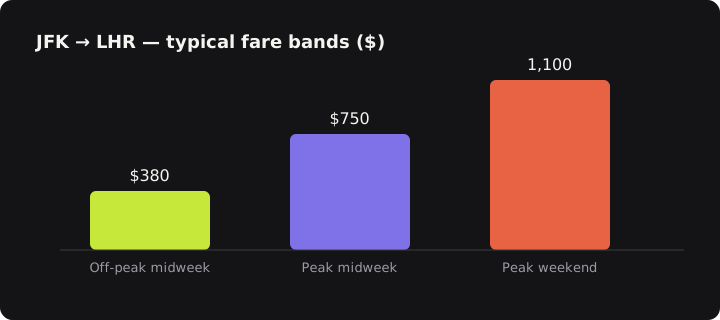
A worked example: watching one fare for 90 days
To make the window concrete, here's how a typical the US international fare behaves over the weeks before departure. The numbers below are the shape of the curve — every route differs, but the pattern is remarkably consistent:
| Weeks before departure | What typically happens to the fare |
|---|---|
| 20+ | Sale fares not yet loaded; prices sit mid-band |
| 12–20 | First sales fire; bottom-of-band fares appear briefly |
| 8–12 | The sweet spot — cheap buckets open, competition active |
| 4–8 | Fares wobble; mid-week sales still land |
| 2–4 | Premium zone begins; each week adds ~5–10% on busy routes |
| 0–2 | Business-traveler territory; expect the top of the band |
Two lessons fall out of that table. First, the difference between booking at 10 weeks and at 2 weeks is often the difference between the bottom of the band ($380) and the top ($1100) — the fare didn't change, the availability did. Second, the dips at 12–20 weeks and 8–12 weeks are exactly the drops you'll miss if you check once and decide "I'll come back later." They last days.
Mistakes that cost readers the most
- Waiting for a "better price" on peak dates. Peak-season fares in the US almost never retreat in the final weeks — waiting converts a mid-band fare into the top of the band.
- Applying domestic windows to international trips. They're different curves. International sale fares load earlier and the premium zone starts sooner.
- Booking the moment a sale opens without checking dates nearby. Sale fares often exist on adjacent dates too — ±1 day can beat the headline fare.
- Trusting a single fare chart. One search shows one moment in time. The window is a probability distribution, not a schedule.
Frequently asked questions
What is the cheapest day of the week to book flights?
None, reliably. Dynamic pricing has flattened day-of-week differences to a few percent. What matters is how far before departure you book — the 1–3 month domestic and 2–6 month international windows — and whether a sale happens to be live when you're watching.
Do flight prices go up the more you search?
No. Fares move with inventory and demand, not search counts. What looks like "going up as I search" is usually the cheapest fare bucket selling out between your checks — which happens whether or not you search.
Is it cheaper to book flights at the last minute?
Almost never in the US. Under 3 weeks out you're buying into the business-traveler premium zone. The exceptions are so rare (specific unsold charter-style routes) that planning around them costs more than it saves.
Is it better to book directly with the airline?
For service and changes, usually yes — the airline controls your reservation. For price, aggregators sometimes undercut, but rebooking help during disruptions is worth a few dollars. Compare total price with bags included before deciding.